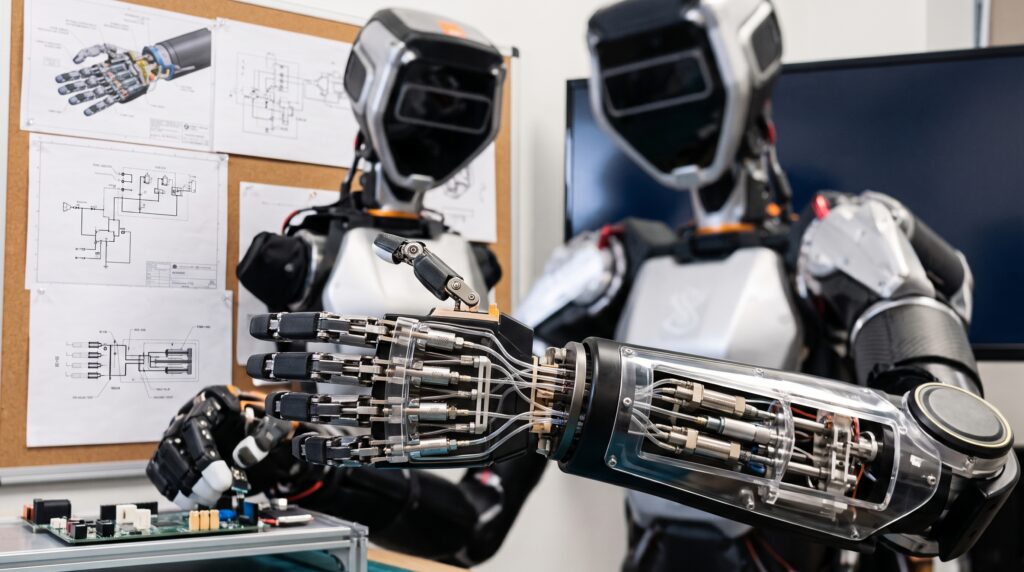
In the contemporary humanoid landscape, an engineering consensus appears to have solidified around electromechanical actuation. Almost every high-profile developer—from Tesla and Figure to Unitree and 1X—has standardized on brushless DC motors mated to planetary, cycloidal, or tendon-driven transmissions. The industry-wide thesis is straightforward: electric systems are clean, quiet, highly efficient, and easily integrated into solid-state digital control buses.
Vancouver-based Sanctuary AI took the road less traveled.
Instead of accepting the physical compromises of electric motors in high-density end effectors, Sanctuary AI committed to a radical mechatronic bet: hydraulic micro-actuation. While Boston Dynamics famously abandoned macro-scale hydraulics in its Atlas platform due to mass, noise, and maintenance headaches on factory floors, Sanctuary recognized that the physics of fluid power invert dramatically when scaled down to the size of a human palm.
Where microscopic electric rotary motors struggle with thermal dissipation, gear backlash, and low peak holding torques, hydraulic micro-pistons provide immense power-to-weight ratios, natural shock compliance, and near-zero latency. By packing custom-machined hydraulic micro-cylinders and sub-millisecond proportional valves directly into the wrist and hand envelope of its Phoenix general-purpose humanoid, Sanctuary AI has developed one of the most dexterous, human-equivalent robotic manipulators in existence.
Demonstration of the Sanctuary AI Phoenix robotic hand flexing fingers via integrated hydraulic micro-actuators.
+---------------------------------------------------------------------------------------+
| KEY TAKEAWAYS                                                                         |
| • Asymmetrical Actuation Strategy: While the locomotion chassis uses clean electric   |
|   drives, the hands and wrists leverage a closed-loop micro-hydraulic network.       |
| • Human-Scale Actuator Density: Packs custom micro-cylinders into the forearm and     |
|   wrist, achieving up to 20 degrees of freedom without bulky distal gearheads.        |
| • Fluid Dynamic Bandwidth: Sub-millisecond valve response times deliver real-time     |
|   haptic compliance and instant force clamping, eliminating destructive over-torques. |
| • Acoustic & Thermal Isolation: High-pressure fluid loops act as native thermal heat  |
|   sinks, routing core operating heat away from delicate fingertip sensor arrays.      |
| • Teleoperation Data Pipeline: Paired with Sanctuary's Carbon AI cognitive architecture|
|   and bilateral haptic rigs, capturing high-fidelity human demonstration physics.     |
+---------------------------------------------------------------------------------------+
Quick Specs: Sanctuary AI Phoenix Hand & Chassis Architecture
Technical Metric
Specification
Engineering Significance
Overall Robot Height
1.70 m (5 ft 7 in)
Direct ergonomic parity with standard human workstations
Total Platform Mass
~70 kg (154 lbs)
Balanced center of mass; stable anchoring during manipulation
Hand Degrees of Freedom (DoF)
Up to 20 DoF per hand
Full human kinematic equivalence; independent digit articulation
Primary Hand Actuation
Proprietary closed-loop micro-hydraulics
High force density in miniature volumes; zero gear backlash
Arm Working Payload
25 kg (55 lbs) continuous lift
Handles heavy industrial tote bins, tooling, and sheet parts
Torque Density at Small Scales: Electric motors generate torque through electromagnetic flux across an air gap. To generate higher torque in an electric motor, you must increase either the rotor radius (which makes the finger too bulky) or pump more current through the copper windings (which generates extreme heat via $I^2R$ resistive losses).
The Fragility of Micro-Gearing: Because tiny electric motors spin at high RPMs with low torque, they require micro-reduction stages (such as 50:1 or 100:1 gearboxes). At millimeter scales, gear teeth are microscopic, fragile, and highly prone to stripping under sudden shock loads, such as accidentally striking a metal table.
Heat Trap in the Hand: Placing 15 to 20 miniature electric motors inside an insulated palm enclosure cooks the onboard tactile sensors, causing thermal drift and premature component degradation.
Sanctuary Micro-Hydraulic Advantage:
[Centralized Mini-Pump & Accumulator] ══[High-Pressure Fluid Line]══> [Micro-Piston (Direct Thrust)]
                                                                               │
[Instant Linear Force, Zero Gears]
Fluid power scales down much more favorably. Force in a hydraulic cylinder equals pressure multiplied by piston area ($F = P \times A$). By operating at moderate to high fluid pressures, a micro-piston the width of a pencil can produce linear forces that would require an electric motor four times its physical volume.
Direct Linear Motion: Hydraulic pistons naturally move back and forth in a straight line. They require zero gears, zero lead-screws, and zero cam mechanisms to actuate a human knuckle or flex a tendon.
Thermal Sink Routing: In a hydraulic hand, heat is carried away by the circulating fluid itself and dissipated through an integrated chassis heat exchanger located in the robot’s torso, leaving the hands and delicate fingertip sensors cool during sustained operations.
Inherent Physical Compliance: Hydraulic fluid, while theoretically incompressible, exhibits slight compressibility through hoses and valve margins. Combined with active fast-switching proportional valves, the system behaves like an adjustable mechanical spring, absorbing heavy dynamic impacts without mechanical fractures.
Internal Anatomy: Micro-Manifolds, Valving, and Tendon Routings
The core innovation of Sanctuary AI’s manipulator lies in the integration of its miniature valve manifold and micro-piston assemblies.
Sanctuary AI Phoenix Manipulator Architecture:
[Forearm Chassis: High-Flow Miniaturized Valve Manifold]
       │
       ├── Proportional Fast-Acting Micro-Valves (<1 ms Switching)
       │
[Wrist Conduit Hub: High-Pressure Flexible Fluid Routings]
       │
[Palm & Digit Core: Array of Miniature Hydraulic Cylinders]
       ├──> Direct Linear Actuation of Metacarpal Joints
       └──> Multi-Link High-Tensile Tendon Channels to Distal Knuckles
              │
       [Integrated Multi-Axis Tactile & Pressure Sensor Matrix]
Micro-Machined Valve Manifolds: Rather than connecting messy individual hoses to every joint, Sanctuary routes pressurized fluid through monolithic, multi-layer micro-machined manifolds housed in the forearm and wrist. These manifolds act like printed circuit boards, but for fluid instead of electricity.
Fast-Acting Proportional Valves: The system uses ultra-low-latency piezoelectric or voice-coil-driven miniature valves capable of cycling in under a single millisecond. By throttling the fluid flow at high frequencies, the control system modulates joint stiffness dynamically—from rigid and unyielding when torquing a wrench, to completely soft and compliant when brushing against a fragile surface.
Tendon-Coupled Distal Links: While the primary palm knuckles and thumb base are driven directly by micro-cylinders, forces to the distal fingertips are transmitted through high-tensile synthetic filaments. This keeps the fingertips ultra-lightweight, minimizing the mechanical momentum of the hand during rapid reaching and grasping motions.
Tactile Sensing and Dynamic Slip Prevention
Human dexterity relies fundamentally on the sense of touch. Humans do not look at their fingers while typing or buttoning a shirt; they rely entirely on mechanoreceptors in their skin that detect normal force, lateral shear, and vibrational micro-slips.
Haptic Closed-Loop Control Loop:
┌────────────────────────────────────────────────────────┐
│ Piezoresistive / Optical Tactile Fingertip Arrays      │
└───────────────────────────┬────────────────────────────┘
                            │ Real-Time Surface Shear Deflection (1 kHz)
┌───────────────────────────▼────────────────────────────┐
│ Low-Level Fluid Pressure Controller                    │
│ • Detects slip within 1.5 milliseconds                 │
│ • Cranks micro-valve position to increment clamp force │
└────────────────────────────────────────────────────────┘
The fingertips of the Phoenix hand are embedded with high-resolution tactile sensing skins.
Shear Vector Tracking: Traditional robotic grippers measure simple vertical compression. Sanctuary’s sensors detect when an object begins to slide horizontally across the silicone skin pad.
Sub-Millisecond Pressure Modulation: When the sensor registers the initial high-frequency micro-vibration of a slip event, the low-level controller instantly adjusts the hydraulic valve spool position. The micro-cylinder increases clamp pressure within 1 to 2 milliseconds, securing the slipping object before human eyes—or vision cameras—could even process the movement.
Delicate Object Handling: Conversely, when grasping fragile packaging, such as an unsealed cardboard box, a plastic cup, or fresh produce, the fluid pressure is metered down to fractions of a bar, applying just enough normal force to overcome gravity without deforming the product.
The functional capabilities of Sanctuary’s hands and teleoperation capture pipelines were demonstrated during retail deployments with Canadian retail giant Canadian Tire and manufacturing pilots with Magna International:
Official Hardware & Dexterity Showcase:
Watch the platform in commercial pilots:Sanctuary AI Phoenix – Inside Commercial Testing
(Watch for: delicate object sorting, fluid wrist articulation during tote unkitting, bilateral teleoperation feedback, and seamless natural-language command execution).
The Carbon AI Engine: Merging Teleoperation with Autonomous Execution
Sanctuary AI does not treat hardware as an isolated product. The Phoenix platform is designed from the ground up as a physical data-collection engine for its proprietary cognitive architecture: Carbon™.
Carbon™ Cognitive and Teleoperation Pipeline:
┌──────────────────────────────────────────────────────────────┐
│ CARBON COGNITIVE & LANGUAGE PROCESSING LAYER                 │
│ • Natural Language Task Decomposition & Semantic Planning    │
│ • Long-Term Spatial Memory & Environmental Context Engine    │
└──────────────────────────────┬───────────────────────────────┘
                               │ Structured Action Primitives
┌──────────────────────────────▼───────────────────────────────┐
│ DUAL-MODE EXECUTION PIPELINE                                 │
│ ┌──────────────────────────┐    ┌──────────────────────────┐ │
│ │ AUTONOMOUS PHYSICAL AI   │    │ BILATERAL TELEOPERATION  │ │
│ │ • Imitation learned VLA  │ OR │ • Remote human pilot     │ │
│ │ • Local closed-loop grasp│    │ • Full haptic force-back │ │
│ └──────────────────────────┘    └──────────────────────────┘ │
└──────────────────────────────┬───────────────────────────────┘
                               │ High-Speed CAN-FD / Industrial Bus
┌──────────────────────────────▼───────────────────────────────┐
│ REAL-TIME MECHATRONIC CONTROLLER (1000 Hz)                   │
│ • Micro-hydraulic valve position and pressure modulation     │
│ • Tactile slip detection and whole-arm collision absorption  │
└──────────────────────────────────────────────────────────────┘
Bilateral Haptic Teleoperation: When tackling novel or complex industrial tasks, human operators pilot Phoenix remotely using high-fidelity motion-capture suits and haptic exoskeleton gloves. Because Phoenix’s hands are hydraulic, the system can measure true physical resistance and stream those exact force vectors back into the operator’s gloves. The pilot literally feels the rigidity, weight, and surface texture of the item the robot is holding hundreds of miles away.
Data-Rich Imitation Learning: Every hour a human spends piloting Phoenix produces clean, synchronized telemetry: multi-camera video streams, joint angles, hydraulic pressure spikes, and tactile shear readings. This high-density data feeds directly into Carbon’s imitation-learning neural pipelines.
Autonomous Task Graduation: Once Carbon observes a task performed under teleoperation across hundreds of variations in lighting, part positioning, and object skew, the neural policy takes over. The task “graduates” from human-piloted teleoperation to 100% autonomous local execution.
Commercial Validation: The Automotive Tier-1 Proving Ground with Magna
Unlike humanoid projects designed primarily for marketing stunts, Sanctuary AI validated its hydraulic end effectors directly within the harsh supply chain of Magna International, one of the largest automotive tier-1 suppliers in the world.
Automotive Commercial Progression:
┌────────────────────────────────────────────────────────────┐
│ Sanctuary AI Engineering Facility (Vancouver, BC)          │
│ • Micro-hydraulic life-cycle endurance and seal testing    │
│ • Carbon AI model training via simulation & teleoperation   │
└─────────────────────────────┬──────────────────────────────┘
                              │ Validated Production Units
┌─────────────────────────────▼──────────────────────────────┐
│ Magna International Automotive Production Facilities       │
│ • Precision parts sorting, kitting, and sub-assembly picks  │
│ • Handling stamped metal brackets and flexible wire harnesses│
│ • Validating MTBF in environments with stamping vibrations  │
└────────────────────────────────────────────────────────────┘
Automotive assembly presents tasks that have resisted conventional industrial automation for decades:
Handling Flexible Materials: Traditional robotic clamps can pick rigid engine blocks, but they fail when handling floppy wire harnesses, rubber seals, and foam insulation. Phoenix’s micro-hydraulic fingers flex compliantly around non-rigid geometry, applying uniform grip pressure without pinching wires.
Kitting and Sequencing: Workers must pull small clips, screws, and brackets from disorganized bins and seat them into precise carrier trays. Phoenix’s tactile feedback loops allow it to isolate single parts from tangled bin clusters.
Surviving Industrial Shocks: Stamping presses produce heavy floor vibrations that throw off delicate optical encoders. The hydraulic damping in Phoenix’s arms and hands naturally filters out high-frequency shop-floor vibrations, protecting internal components.
Sanctuary AI’s deployment of micro-hydraulics in the Phoenix hand demonstrates that the future of humanoid manipulation does not belong to a single actuation dogma. While electric motors will dominate locomotion and macro joints, the physics of fluid power—when re-engineered at the millimeter scale—provides a compelling, durable, and human-equivalent solution to the ultimate robotics frontier: true manual dexterity.
Explore related platforms and technical profiles in the Bot.to Humanoid Directory or read our direct hardware breakdown: Sanctuary AI Phoenix vs. Figure 02: Teleoperation Telemetry vs. Autonomous End-to-End VLA.